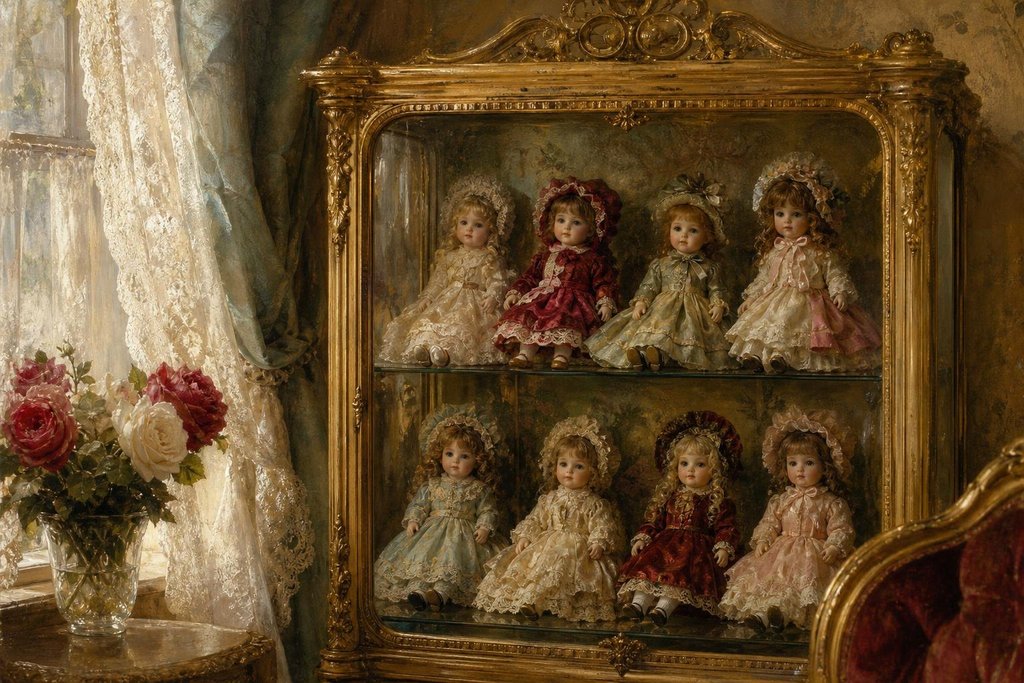

The Celebrity Collector: Lana Wood
The actress best known as Plenty O’Toole in Diamonds Are Forever rebuilt a childhood doll collection with her daughter and spent a lifetime gathering Victorian and vintage jewelry.
Lana Wood, Plenty O’Toole in Diamonds Are Forever
In the 1971 James Bond film Diamonds Are Forever, Lana Wood played Plenty O’Toole opposite Sean Connery, and her best-remembered moment came when her character was thrown out of a Las Vegas hotel window and landed in the pool below. That really was Wood, not a stunt double.
The crew told her not to worry because they would be shooting in the middle of the night. “But it was Las Vegas,” she said. “Half the world’s up in the middle of the night in Las Vegas! There were all these people trying to get a look at me from their windows. It was quite the scene.”
Producer Albert “Cubby” Broccoli had offered her the part. Away from the screen, Wood built two collections that had nothing to do with spy films: Madame Alexander dolls and vintage jewelry.
Lana Wood’s childhood Madame Alexander dolls
Her interest in Madame Alexander dolls came in two parts. The first was in childhood in Santa Monica, California, where she grew up with her parents, her sister Natalie and a half-sister, Olga. Her parents, Russian immigrants Nikolai and Maria Zacharenko, gave the dolls to young Svetlana, Lana’s real name, as presents. Her father built an elaborate three-shelf unit in her closet to hold them, and she had the accessories too, from tiny picnic tables to miniature pies.
“I loved those little dolls. They were such a major part of my childhood,” she said, “but somehow, over the years, they just disappeared. I have no idea what happened to them. And that’s very sad. I’d love to have them back.”
Madame Alexander dolls were made by the Alexander Doll Company, founded in New York by Beatrice Alexander in the 1920s. The company became known for small, carefully costumed dolls based on characters from literature, history and around the world, which is why collectors often build their holdings around themes.
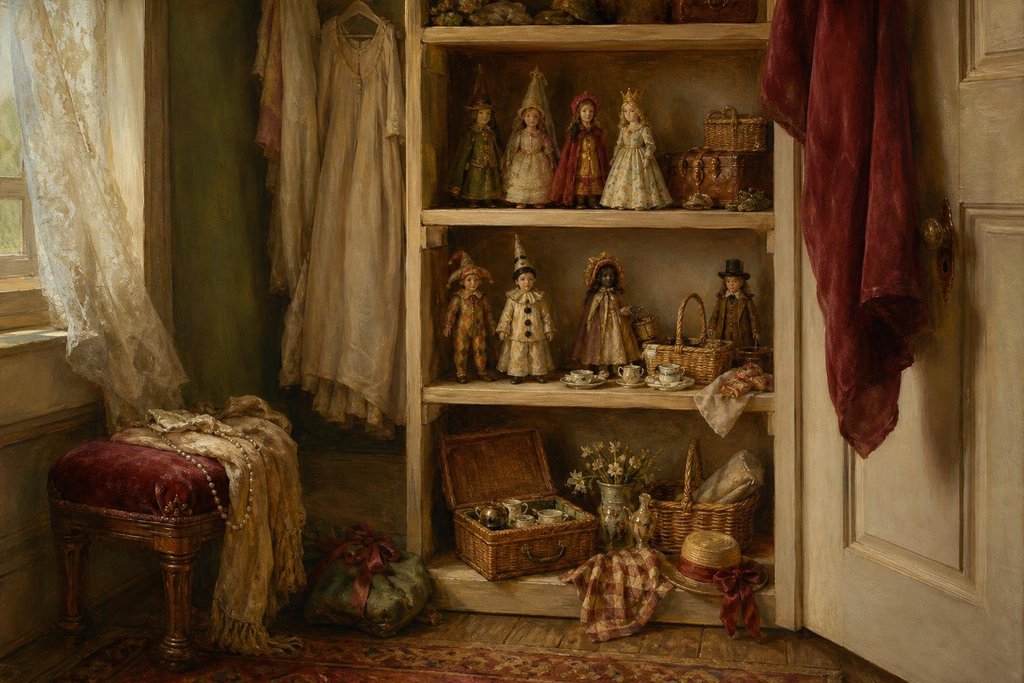
Rebuilding the collection: about 200 dolls
The second part began roughly a dozen years before the 2007 interview. Wood was shopping in Los Angeles with her daughter, Evan, when they saw a Madame Alexander doll with a Little Women theme. “We both fell in love with it and bought it on the spot for $50,” she said.
From then on the collection was a joint project. “We decided to become knowledgeable about the dolls, and picked up some catalogs to look through,” Wood said. “After that, we just went wild and bought everything we saw that struck our fancy.” By 2007 they had about 200 dolls, most of them 6 inches tall and some 10 inches, displayed in several rooms and in a curio cabinet at their home in Ventura County, California.
A few stood out. One was a 10-inch Christmas caroling doll she found in a local florist’s shop. “This doll should have been priced at $200 or more,” she said. “I don’t think the lady knew what she had. I bought it dirt cheap, for just $25.” The collection also included many of the company’s Halloween dolls, issued one a year (the previous year’s was a girl dressed as a goldfish), a doll modeled on the Mona Lisa and a French court girl in a powdered wig.
Buying for love, not money
Most of the dolls were current issues, and Wood had no illusions about resale. “We buy what we love and don’t expect to ever get ten cents back on the dollar if we decide to sell them,” she said. “But that’s not what drives us to collect. We just love the dolls. It’s a passion thing.”
Theme and costume decided most purchases. “If it has an interesting theme or if the doll has been dressed in a costume that catches our fancy, we’ll end up buying it,” she said. “A collection should be about love, not money.”
That approach is a sensible one with recent collectible dolls. Pieces produced in quantity for collectors rarely gain much in value, and the people who enjoy them most tend to buy the way Wood did, by subject and by eye.
Victorian lockets, pins and poison rings
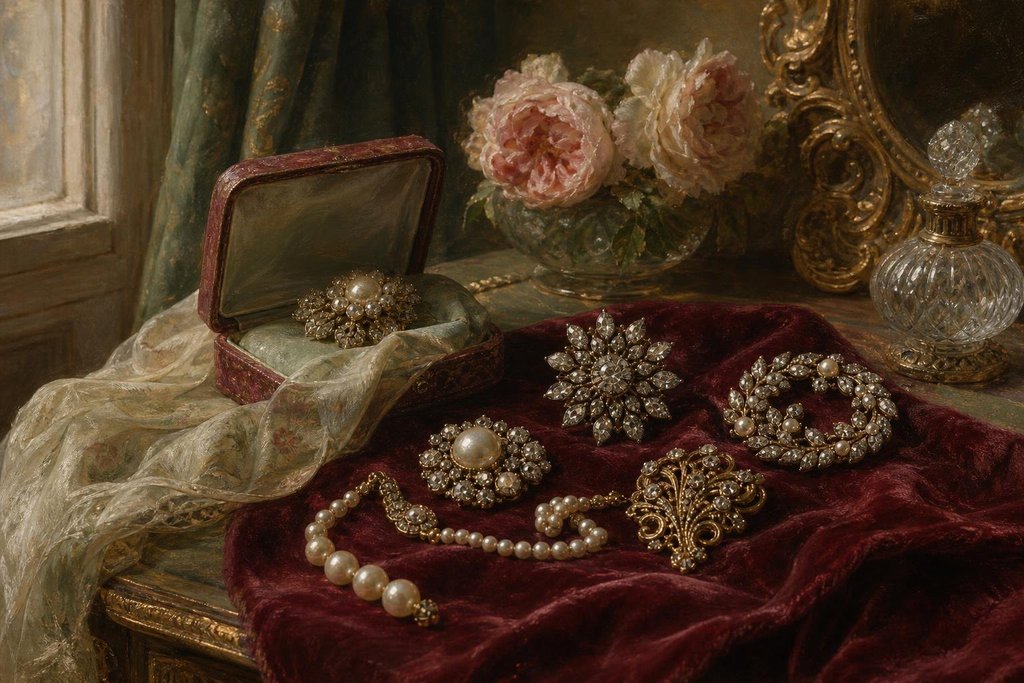
The jewelry collection had grown without a break since Wood was a child. It started with a piece of her mother’s. “My mother had a Victorian hair locket with a lock of Natalie’s hair, and I just loved that little piece,” she said. Years later she bought a similar locket in Beverly Hills for her niece Natasha. Keepsakes made with hair were a Victorian habit, and the period’s fascination with hair also produced the hair receiver on the dressing table.
By 2007 her collection included about seven small Victorian pins. One was inlaid with pearls, turquoise and rubies in a tulip design, one was enamel with what looked like a foreign military theme, and one was a small frog of marcasite and diamonds. She always wore a gold Russian cross on a gold chain, a childhood gift from a relative, and she owned a scrollwork heart ring with a semi-transparent silver heart and a garnet.
Other pieces included Victorian-era Russian amethyst and enamel earrings about two inches long, bought at Frances Klein in Los Angeles; a heavy 1960s gold chain with a 6-inch ankh; a carnelian scarab ring; an Art Nouveau bracelet “that I simply adore, with each disc a water lily”; and several marcasite bracelets.
She also had about ten poison rings, which open to reveal a small hidden compartment, said to have been meant for a dose of poison. They belong to the same fascination with secret containers and deadly contents that drives collectors of antique poison bottles.
At about 14, on the set of Five Finger Exercise, her mother promised her a ring if she stopped biting her nails. It worked, and she received a modern gold ring with a center pearl and four diamonds. Her preference for vintage pieces emerged a few years later, around the time she joined Peyton Place.
Lana Wood’s career in film and television
Lana Wood was born on March 1, 1946. Her parents were Russian by heritage and had both left the country after the Communist takeover. They met and married in San Francisco and changed the family name from Zacharenko to Gurdin. Natalie, born Natasha in San Francisco in 1938, later took the name Wood in honor of director Sam Wood, at their mother’s suggestion. She was already a child star in films such as Miracle on 34th Street (1947), so Lana took the same surname for her own credits.
The sisters appeared in some of the same films. Lana had a baby part in Driftwood that was cut, played a younger version of Natalie’s character in John Ford’s The Searchers (1956), and appeared with her in Marjorie Morningstar (1958). Television let her work on her own, in Playhouse 90, Dr. Kildare and The Fugitive.
In 1965 she signed with Twentieth Century-Fox and became a series regular on The Long Hot Summer, playing the Southern belle role Lee Remick had played in the film. Her break came in 1966 as the waitress Sandy Webber on Peyton Place, often called the first prime-time soap opera. After the Bond film came Disney’s Justin Morgan Had a Horse (1972), Grayeagle (1978) and Satan’s Mistress (1982). Among other Bond actresses, Ursula Andress also had a collection worth seeing.
In the early 1980s Wood was vice president of TV films for Ron Samuels Productions at Warner Bros. Her book Natalie: A Memoir by Her Sister reached No. 3 on the New York Times best-seller list, and in 2004 she co-produced the ABC television film The Mystery of Natalie Wood.
Questions and answers
What does Lana Wood collect?
Lana Wood collected Madame Alexander dolls and vintage jewelry. In 2007 she and her daughter Evan owned about 200 dolls, mostly 6 inches tall. Her jewelry included Victorian pins, a Victorian hair locket, Russian amethyst and enamel earrings, a carnelian scarab ring, an Art Nouveau water lily bracelet and about ten poison rings.
Who did Lana Wood play in Diamonds Are Forever?
Lana Wood played Plenty O’Toole opposite Sean Connery’s James Bond in the 1971 film Diamonds Are Forever. In her best-known scene, her character is thrown from a Las Vegas hotel window into a pool. Wood did the scene herself rather than using a stunt double, and it was filmed in the middle of the night.
How many Madame Alexander dolls does Lana Wood have?
In 2007 Lana Wood and her daughter had about 200 Madame Alexander dolls, displayed in rooms and a curio cabinet at their home in Ventura County, California. The collection restarted with a Little Women doll bought for $50 and includes Halloween dolls, a Mona Lisa doll and a French court girl.
Is Lana Wood related to Natalie Wood?
Yes. Lana Wood is Natalie Wood’s younger sister. Their parents, Russian immigrants Nikolai and Maria Zacharenko, changed the family name to Gurdin. Natalie took the name Wood in honor of director Sam Wood, and Lana used the same surname. Lana played a younger version of Natalie’s character in The Searchers.
What TV shows was Lana Wood in?
Lana Wood appeared in Playhouse 90, Dr. Kildare and The Fugitive, then became a regular on The Long Hot Summer after signing with Twentieth Century-Fox in 1965. Her breakthrough came in 1966 as Sandy Webber, a waitress, on Peyton Place.