
The Celebrity Collector - Olivia Hussey
Zeffirelli’s teenage Juliet grew up with little religion, then filled almost every room of her house with statues of gods and saints. The one piece with real market value came from the film set.
Olivia Hussey, Juliet at 15
Olivia Hussey was 15 when she played Juliet in Franco Zeffirelli’s 1968 film of Romeo and Juliet. The role won her a Golden Globe and two David di Donatello awards, Italy’s equivalent of the Oscars, although she received no Oscar nomination.
By 2003 she had been acting for more than 35 years. She credited her looks to a mix of English and Argentine roots. Her father was Andreas Osuna, also known as Isvaldo Ribo, an Argentine opera and tango singer. Her English mother encouraged her interest in performing and enrolled her in drama classes at age 7.
Before Juliet, Hussey had appeared on the London stage opposite Vanessa Redgrave in The Prime of Miss Jean Brodie, playing Jenny. Zeffirelli saw her while he was searching for his Juliet and invited her to audition. She competed with 500 other hopefuls and won the part.
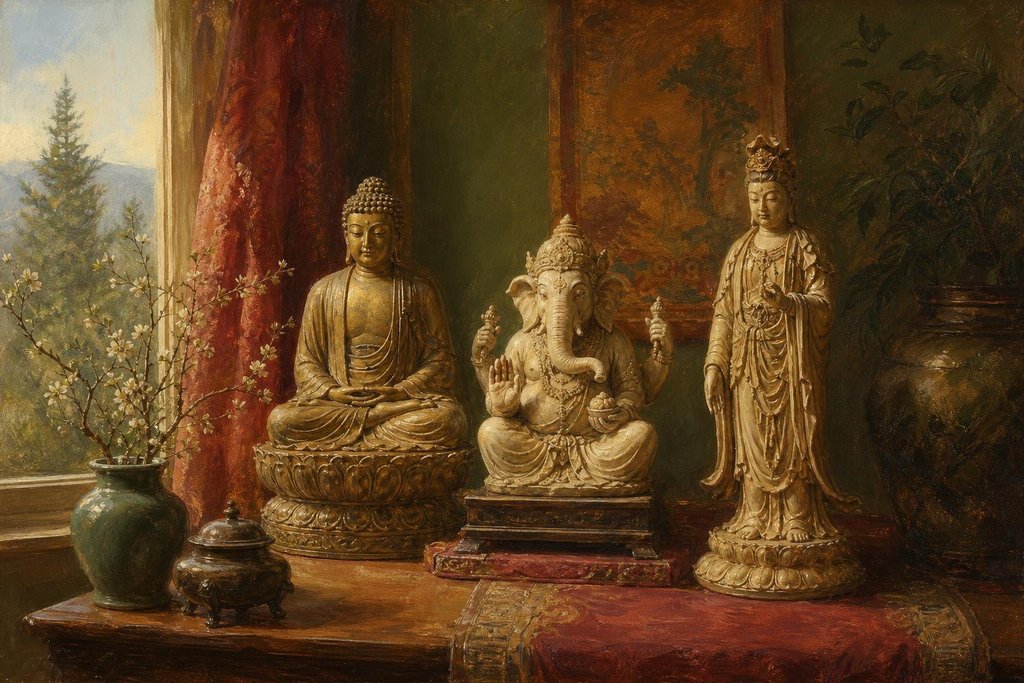
About 70 statues of Buddha, Ganesh and Quan Yin
Her upbringing was fairly secular, but her adult life was closely tied to spirituality, and her house showed it. In 2003 she owned about 70 statues of religious figures, including Buddha, Ganesh, Krishna, Quan Yin and Lakshmi, spread through the home in northern California she had just moved into.
“I’m not necessarily a religious person,” Hussey said, “although I belonged to the Church of England when I was young and have always enjoyed the serenity and calm that comes with attending church service. But I am very spiritual. The statues are little reminders that God is everywhere in a person’s life, at least my life. They’re certainly everywhere in the house, just about every room!”
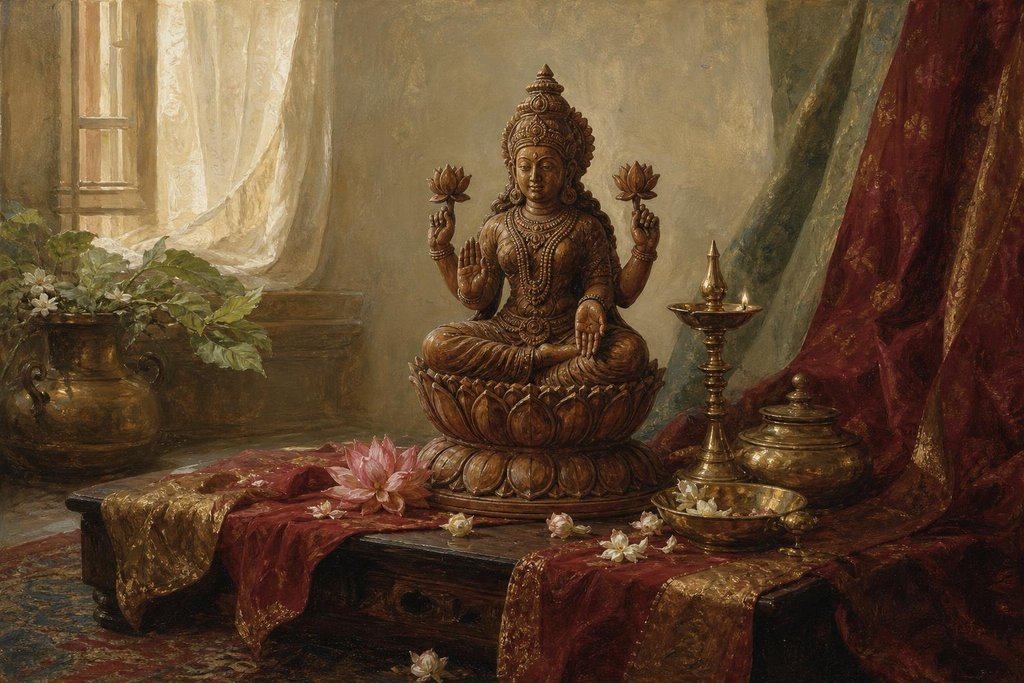
She explained the figures as she pointed them out. “Ganesh is the elephant God from India,” she said. “He has the head of an elephant and the body of a man. He’s the remover of obstacles. Quan Ying is the goddess of fertility. And Lakshmi is the Indian goddess of wealth. You see her a lot in Indian shops and restaurants. And, of course, I’ve got lots of Buddha statues.”
These are some of the most widely made devotional figures in Asia. Ganesh is honored across Hindu tradition and is usually shown with an elephant head and a broken tusk. Quan Yin, often spelled Guanyin, is a Buddhist figure of compassion venerated across China and East Asia. Lakshmi is typically shown seated or standing on a lotus. Statues of all of them are produced in brass, bronze, wood, stone and resin, from temple-sized figures down to pieces small enough for a shelf.
Gift-shop finds and a love of elephants
Most of Hussey’s statues were small and had little value as collectibles. What mattered to her were the memories and the meaning attached to them. “Some I’ve picked up in gift shops, others at what I guess you’d call self-actualization centers,” she said. “If it’s a figure that reminds me of God, I’ll buy it. And elephants,” she added. “I’ve got lots of elephants, too!”
Collections built this way are common, and they follow a different logic from collecting for investment. Condition and maker matter less than the subject, and pieces arrive as souvenirs and gifts as often as purchases. Catherine Hicks gathered her Madonnas in much the same way, a statue here and a picture there.
Her interest in Eastern spiritual figures went back to an evening in England when she was 22. A friend persuaded her to attend a house gathering to hear the teacher Swami Baba Muktananda. She sat at the back, and at the end he walked up to her and told her, in Hindi, that she was not meditating. She began meditating on the spot and became a devotee of Muktananda and the Siddha Yoga Foundation. He died in 1982.
The Black Madonna fresco and the Romeo and Juliet cross
Not every piece came from Asia. Hussey kept a cross on a prayer table, a glass heart from her friend and spiritual mentor Howard Wills, and a fresco painting of the Black Madonna of Poland. “The Black Madonna is famous because it was the only thing left when Nazis burned a church during World War II,” she said. “A Polish priest painted a beautiful version of it and gave it to me.”
The one item with real dollar value predated her spiritual interests: the cross she wore around her neck as Juliet. “I actually thought about posting it on eBay, just to see how much I could get for it,” she said, laughing. “I know movie memorabilia can be very valuable. I would never think of selling it, though.”
Costume pieces and props worn on screen in a well-known role are the kind of film memorabilia that draws strong interest, particularly when the history of the piece can be traced back to the production. Anyone curious about how such items move on the open market can read the guide to selling on eBay.
Olivia Hussey’s film career after Romeo and Juliet
Hussey worked steadily after 1968. She reunited with Zeffirelli for Jesus of Nazareth and appeared in Death on the Nile with Bette Davis and Peter Ustinov, The Last Days of Pompeii with Laurence Olivier, and Stephen King’s It. On television she starred in the Hallmark Hall of Fame production of Ivanhoe with James Mason and in Showtime’s Psycho IV.
In 1985 she starred with Burt Lancaster and Ben Cross in a screen version of The Jeweler’s Shop, a play by Karol Wojtyla, better known as Pope John Paul II. The film was never released for general distribution, but it was screened at the Vatican, and Hussey attended as a guest of the Pope. “What an experience that was!” she said.
For ten years before the 2003 interview she had been working to bring the life of Mother Teresa to the screen, with herself in the lead, under the working title Teresa of Calcutta. Richard Harris narrated a promotional clip, and Martin Sheen had told her he wanted to take part. Her husband, the musician and actor David Glen Eisley, planned to develop film projects with her through their company, Frozen Flame Enterprises. Her other screen contemporaries with collections of their own include Ursula Andress.
Questions and answers
What does Olivia Hussey collect?
Olivia Hussey collected spiritual statues. In 2003 she had about 70 figures of Buddha, Ganesh, Krishna, Quan Yin and Lakshmi spread through her home in northern California, along with many elephants, a cross on a prayer table, a glass heart from a mentor and a fresco painting of the Black Madonna of Poland given to her by a Polish priest.
How old was Olivia Hussey in Romeo and Juliet?
Olivia Hussey was 15 when she played Juliet in Franco Zeffirelli’s 1968 film Romeo and Juliet. She won the part over 500 other hopefuls after Zeffirelli saw her on the London stage in The Prime of Miss Jean Brodie. The role brought her a Golden Globe and two David di Donatello awards.
Did Olivia Hussey keep her Juliet cross?
In 2003 she did. Hussey said the cross she wore around her neck in Romeo and Juliet was probably the only item she owned with real dollar value. She joked about putting it on eBay to see what it would bring, but said she would never think of selling it.
Are Olivia Hussey’s statues valuable?
Mostly not, by her own account. The statues were small and many came from gift shops or what she called self-actualization centers. She bought any figure that reminded her of God. Their worth to her lay in the memories and spiritual meaning they carried rather than in their price.
What was The Jeweler’s Shop with Olivia Hussey?
The Jeweler’s Shop was a 1985 film based on a play by Karol Wojtyla, later Pope John Paul II. Hussey starred alongside Burt Lancaster and Ben Cross. It was never released for general distribution but was screened at the Vatican, where Hussey attended as a guest of the Pope.