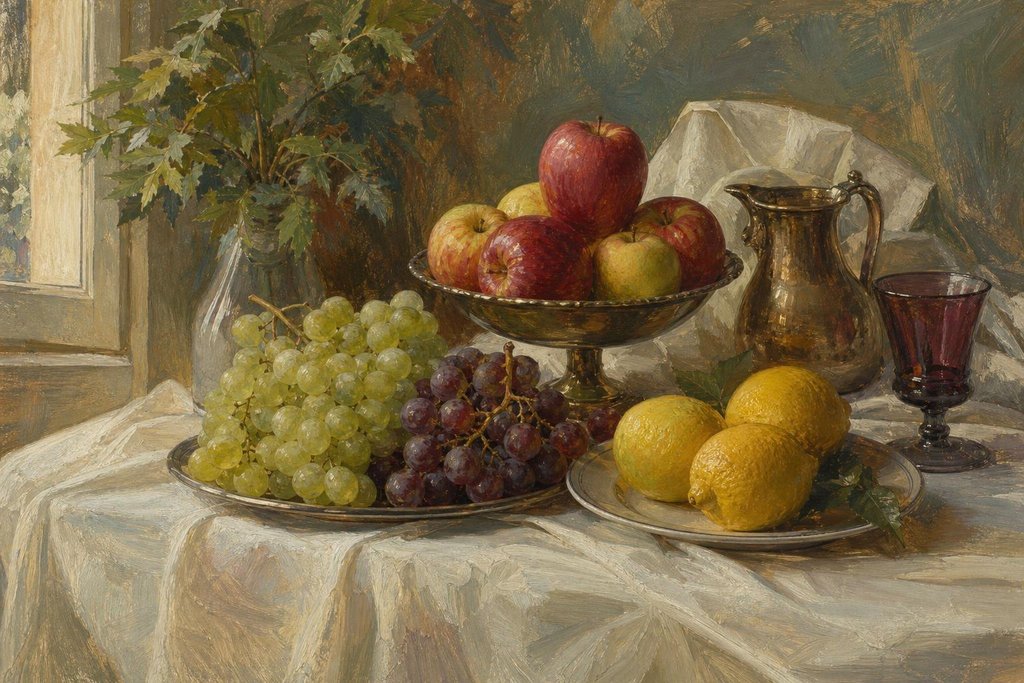

Paul Gauguin's Fruits on a Table
An 1889 still life by Paul Gauguin vanished from a London apartment, rode a train across France and spent four decades with a Turin factory worker who paid next to nothing for it.
Fruits on a Table, painted by Paul Gauguin in 1889
Fruits sur une table, or Fruits on a Table, is a still life painted by Paul Gauguin in 1889. It is famous for two reasons: the man who painted it, and the story of what happened to it after 1970.
Gauguin (1848 to 1903) came to painting late. He worked as a stockbroker in Paris and painted on weekends before turning to art full time in the 1880s. By 1889 he was working in Brittany, where he and a circle of younger painters around Pont-Aven moved away from the soft, broken color of Impressionism toward flat areas of strong color and firm outlines. The year before, he had spent a short and stormy stretch painting alongside Vincent van Gogh in Arles. In 1891 he left France for Tahiti, and the South Seas pictures he made there are the works most people now connect with his name.
Still lifes have a modest place in his output compared with his figures and landscapes, but they show the same habits: bold color, simplified shapes and a tabletop tipped up toward the viewer. Fruit on a cloth was a standard studio subject, and painters of the period, Paul Cézanne above all, used it to work out new ideas about form and color without needing a model or a view.
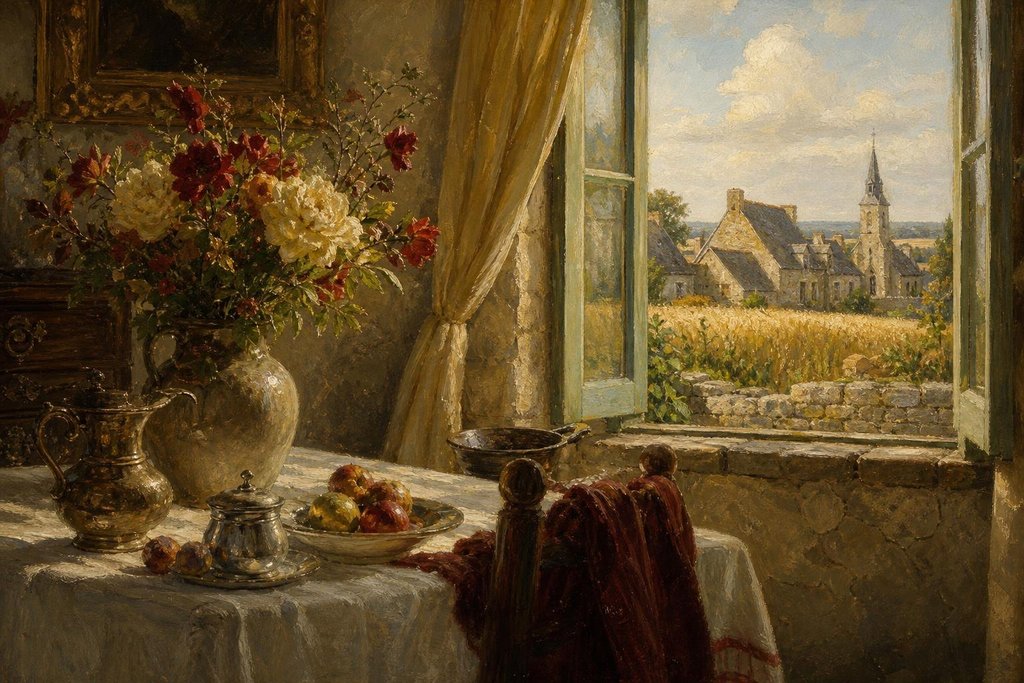
The 1970 theft from Sir Mark Kennedy’s London apartment
In 1970, Fruits on a Table and a second painting, Woman With Two Armchairs by Pierre Bonnard, were stolen from the London apartment of Sir Mark Kennedy and his wife, Mathilda Marks. She was the daughter of the founder of Marks & Spencer, the British retail, home and food chain, which was established in 1882 and in 2017 had 1,382 stores worldwide.
Bonnard (1867 to 1947) belonged to the generation that followed Gauguin. As a young man he was part of the Nabis, a group of French painters strongly influenced by Gauguin’s flat, decorative color, so the two stolen pictures had a real artistic link as well as a shared fate.
After the burglary the paintings seemed simply to disappear. The thieves took them onto a train and traveled across France. At Turin, Italy, they got off and left the paintings on board. Whether they feared being caught is unknown, because they were never found.
Lost property in Turin and a $25 railway auction
Railway workers did find the paintings. Not knowing what they were, they put them in the lost and found storage area, where they sat for five years. Then, in a Turin railway auction of unclaimed property, both pictures were bought by a Fiat factory worker for about $25.
For nearly 40 years the paintings stayed with him and hung on his wall. Lost property sales of this kind usually move umbrellas, luggage and household goods in bulk, and buyers rarely know much about what they are bidding on. Buyers bid on what they can see, with little or no information about where an item came from or who once owned it.
The truth came out only when the owner’s son saw Fruits sur une table reproduced in an art book. That is how the family learned what the painting was worth and that it had been stolen. Father and son contacted the police, who took possession of both pictures.
How an Italian court awarded the Gauguin to a Fiat worker
The case did not end with the recovery. Under Italian law, if no one claims a lost or stolen item and it was bought in good faith by someone who did not know it was stolen, a court can award it to the last person who possessed it. Sir Mark Kennedy and Mathilda Marks had no children, and no other claimants came forward.
In 2014 an Italian court awarded both paintings to the retired Fiat worker. That year Fruits sur une table was valued at £8 million to £25 million, and Woman With Two Armchairs at about £500,000. The owner, who asked not to be named, said he planned to sell the paintings privately. No sale was reported afterward.
Good-faith purchase rules differ sharply from country to country. In England and the United States a thief cannot pass on good title, so a stolen work generally stays the property of the original owner however many times it is sold. Several continental European systems give more protection to an innocent buyer, which is why the Italian ruling surprised many people outside Italy. It is also one reason museums and great private collections spend so much effort on provenance, the documented history of who owned a work and when.
Gauguin’s When Will You Marry? and the $300 million sale
Gauguin’s market reached a new height a year after the court ruling. His Tahitian painting Nafea Faa Ipoipo (When Will You Marry?) was bought by the State of Qatar in 2015 for an undisclosed sum believed to be about $300 million. If that figure is right, it tied with Willem de Kooning’s Interchange, which also sold for $300 million in 2015, as the most expensive painting sold up to that time.
Set beside that price, the $25 paid at a Turin lost property sale makes the story of Fruits on a Table hard to forget. It is a reminder that a painting’s history, and not only its maker, can make it famous. Readers who enjoy stories of art and its rediscovery may also like the account of the painter Moldovan, and more objects with remarkable pasts appear in the article index.
Questions and answers
Who painted Fruits on a Table?
Fruits on a Table, or Fruits sur une table, was painted by the French artist Paul Gauguin in 1889, while he was working in Brittany, two years before he left for Tahiti. It is a still life of fruit on a tabletop, and it is known as much for its theft and recovery as for its painter.
How was Gauguin’s Fruits on a Table stolen and found?
It was stolen with a Bonnard painting from Sir Mark Kennedy’s London apartment in 1970. The thieves left both on a train in Turin, Italy. Railway staff stored them as lost property, and five years later a Fiat worker bought them at a railway auction for about $25. His son recognized the Gauguin in an art book decades later.
Who owns Fruits on a Table now?
In 2014 an Italian court awarded the painting to the retired Fiat factory worker who had bought it in good faith, because the original owners had no children and no claimant had come forward at the time. He asked to remain anonymous and said he planned to sell the paintings privately. The sole heir of the original owner was later found and has challenged the worker's title. No outcome and no sale have been reported.
How much was Fruits on a Table worth?
In 2014, Fruits sur une table was valued at £8 million to £25 million. The second stolen painting, Woman With Two Armchairs by Pierre Bonnard, was valued at about £500,000. The Fiat worker had paid about $25 for both at a Turin railway lost property auction in the mid-1970s.
Which famous paintings of fruit are best known?
Still lifes of fruit were a standard subject for painters in the late 1800s. Paul Cézanne’s apples are the best-known examples, and Gauguin’s Fruits on a Table from 1889 is famous for its unusual history: stolen in London, abandoned on a train in Turin and sold as lost property for about $25.