
The Celebrity Collector - Bryan Cranston collects baseball (and Dodgers) memorabilia
As a boy in Hollywood, the future Malcolm in the Middle father filed his baseball cards by team and rearranged his pennants with the standings. As an adult he rebuilt a collection around the Dodgers and the 500 Home Run Club.
Bryan Cranston and the Dodgers of the early 1960s
The early 1960s were a good time to be a baseball fan, and an especially good time to root for the Los Angeles Dodgers. “Da Bums” had only recently moved west from Brooklyn, leaving behind a crowd of heartbroken fans and bringing some of the brightest stars of the day: Don Drysdale, Sandy Koufax, Maury Wills, Tommy and Willie Davis, Wally Moon and Johnny Roseboro among them.
For a boy in the Los Angeles area it was also the right moment to collect their cards. The period is remembered as a golden age of the game and of card collecting alike, when Topps was, for the most part, the only company in the business. Bryan Cranston, who at the time of a 2004 interview played the quirky father on the Fox comedy Malcolm in the Middle, collected those cards with real passion.
Cards of that era were sold in wax packs with a slab of gum, and most of them were handled hard: traded, flipped, rubber-banded and carried around in back pockets. That is one reason clean examples from the early 1960s are scarcer than the size of the print runs would suggest.
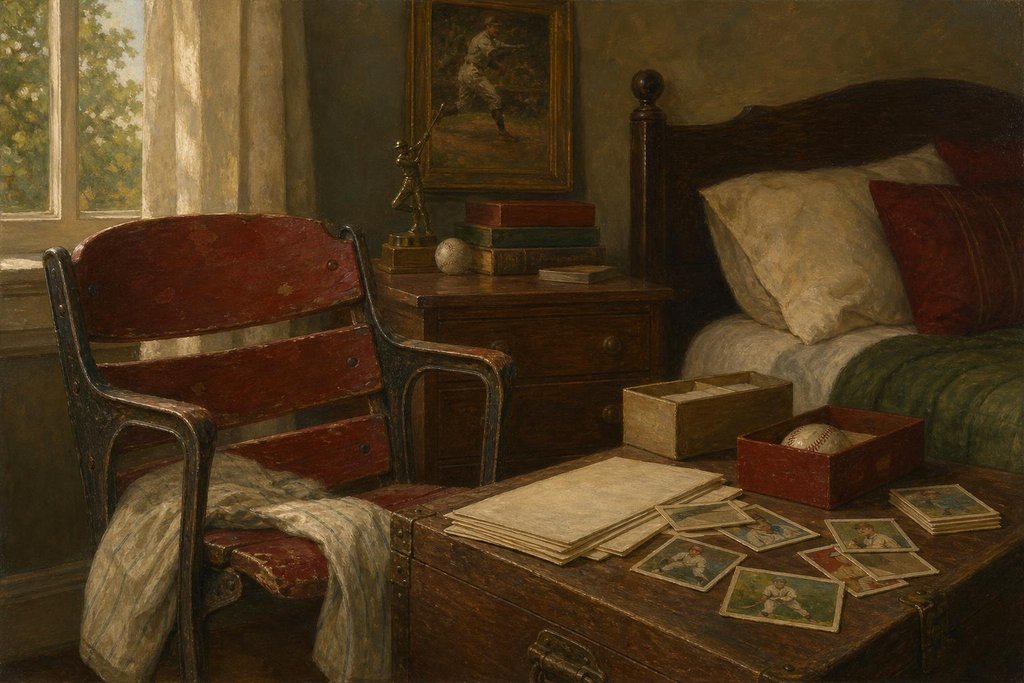
A boyhood baseball card collection sorted by team
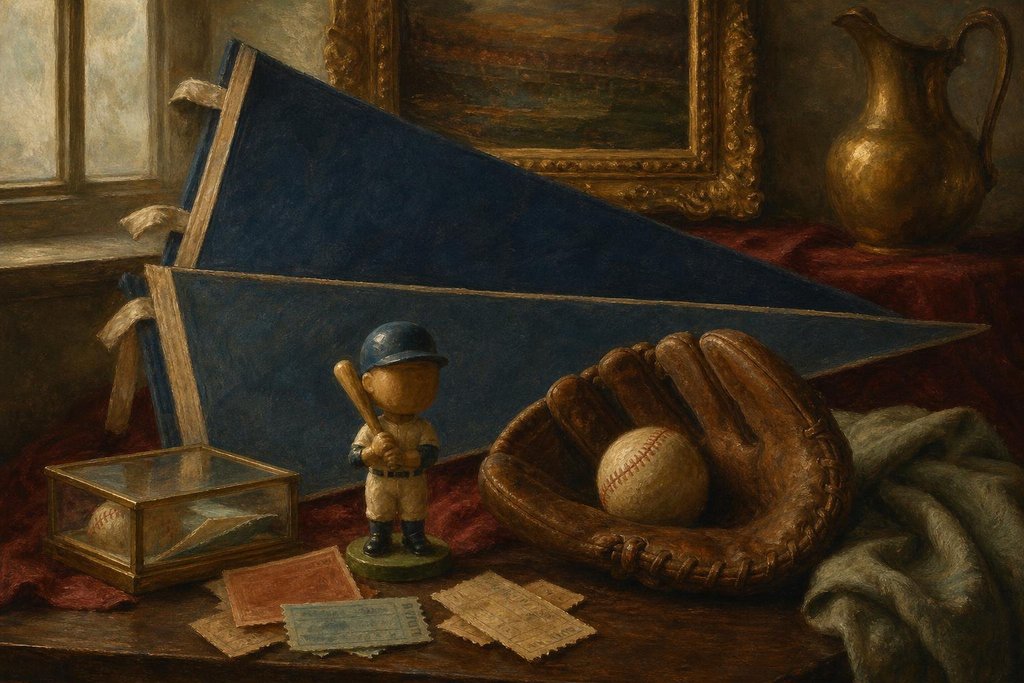
“I had all my cards divided up into teams, neatly arranged in file boxes in my room,” Cranston recalled from his home in Sherman Oaks, California. He also owned a cloth pennant for every team, each one earned by redeeming Bazooka Joe bubble gum comics. “Each one was protected by cellophane and hung on the wall.”
He took the pennants seriously. They were arranged by league and division and rigged so they could be moved to match that day’s standings. “If one team passed another because of who’d won or lost the day before, I switched the pennants around,” he said. “I actually punched grommets into the pennants and screwed cup-hooks into the wall.”
Duplicates had a rougher life. A spare card would usually end up clothespinned to the spokes of his bicycle to give it the motorcycle sound every kid on the block wanted. Cranston was growing up in Hollywood itself, collecting cards and bleeding Dodger blue, but most of what he gathered as a boy was lost over time.
Building a Dodgers and baseball memorabilia collection as an adult
His enthusiasm for the game never faded, and as an adult he gradually built a modest collection of baseball memorabilia, most of it kept and displayed in the game room of his home. One survivor from his childhood is a Dodgers doll with real cloth pants. “He’s wearing what looks like lipstick and rouge,” Cranston said. “I’m not quite sure what that’s all about.”
One of his prized pieces is an Atlanta Braves jersey signed by nine members of the 500 Home Run Club, the players who hit at least 500 home runs over their careers, a group that includes Mickey Mantle and Willie Mays. “I bought it at a charity auction,” Cranston said, “one that I had donated items for. But when I saw that shirt, I became a buyer, too.”
The jersey hangs in a shadow box frame in the game room. By 2004, five more players had joined the club since the auction: Barry Bonds, Eddie Murray, Mark McGwire, Sammy Sosa and Rafael Palmeiro. Cranston wanted to put a latch on the frame so he could take the jersey out whenever a signature opportunity came up, “then I can just pop the shirt back into the frame.”
A shadow box keeps dust and handling away from a signed shirt. Collectors of signed fabric also tend to keep it out of direct sunlight, which fades marker ink and cloth alike.
A 40th birthday at Dodger Stadium and a Reggie Jackson ball
For his 40th birthday, his wife, Robin, threw him a surprise party at Dodger Stadium. No players were there, but friends and family brought gifts, many of them baseball-related: a ball and rookie card signed by Cal Ripken Jr., early pictures of Maury Wills, and second-year cards of Sandy Koufax and Don Drysdale, two of his boyhood heroes. “They’re all in my display case,” he said. The collection also holds a ball carrying the signatures of Carl Erskine and Ralph Branca, both Brooklyn Dodgers.
One ball stays out of the case. It was signed by “Mr. October,” Reggie Jackson, who appeared as a guest on Cranston’s show. “I just asked him, ‘Hey, Reggie, can you sign a ball for me?’ He was happy to oblige,” Cranston said. He kept it in his dressing room, although it brought back “some not-so-fond memories of that ’77 Series, when Reggie homered three times in one game against my Dodgers.” Those three home runs came in Game 6 of the 1977 World Series, the game in which the New York Yankees won the title.
Young Bryan Cranston, from a United Way ad to police science
Cranston was born March 7, 1956, in Hollywood. He got his first acting job at eight, when his father, an actor and semi-regular on The Donna Reed Show and My Three Sons, cast him in a public service ad he produced for the United Way. “I played a kid who gets hit by a car retrieving a baseball,” Cranston said with a laugh. “They had to put me in a full body cast.”
Even so, he enrolled at Valley College in Van Nuys, California, planning to become a policeman, and his degree was in police science. He took some dramatic arts courses as well and liked what he found. “The girls were cuter, the work was more interesting, the hours were better,” he said.
After graduation he did not go straight into police work. He and his brother set off on a motorcycle trip across the country, and on the Blue Ridge Parkway in Virginia a rainstorm kept them in a picnic area for six days. They lived on bouillon cubes and dried noodle soup while Cranston read the one book of plays he had packed. “It made me realize I loved acting,” he said.
Bryan Cranston’s television and film career up to 2004
After two years of motorcycling around, he landed in Daytona Beach, Florida, where he acted in, produced and directed community theater, including Barefoot in the Park, A Funny Thing Happened on the Way to the Forum, Damn Yankees and Night of the Iguana. His first television part was on CHiPs in 1982. His first major role was Douglas Donovan on the daytime drama Loving, which he left after the 1984 season. In 1986, while filming an episode of Airwolf, he met actress Robin Dearden, who was also guest-starring, and later married her.
By 2004 he had acted in more than 50 television programs, among them Seinfeld as the dentist Dr. Tim Whatley, The King of Queens, Murder, She Wrote and L.A. Law, and the Malcolm role had earned him Emmy and Golden Globe nominations. His 39 film credits included two Tom Hanks pictures, That Thing You Do! (1996) and Saving Private Ryan (1998), where he played the War Department colonel who sends out the mission. He worked with Hanks a third time as astronaut Buzz Aldrin in the miniseries From the Earth to the Moon (1998).
In the mid-1990s he gave Robin a screenplay he had written, Last Chance, as a birthday present. The two made the film together, each in a major role, and it became his debut as writer and director, screening at major festivals and taking top honors at several. He also wrote and produced KidSmartz, a DVD program that gives parents and schools information on preventing child abductions and other childhood hazards. Other actors with collections built around their own pasts include Corbin Bernsen and Billy Gray.
Questions and answers
What did young Bryan Cranston collect?
As a boy in Hollywood in the early 1960s, Bryan Cranston collected Topps baseball cards and kept them sorted by team in file boxes in his room. He also had a cloth pennant for every team, earned by redeeming Bazooka Joe comics, and rearranged them on the wall to match each day’s standings. Most of that boyhood collection was lost over time.
What baseball memorabilia does Bryan Cranston own?
In 2004 his collection included an Atlanta Braves jersey signed by nine members of the 500 Home Run Club, bought at a charity auction and kept in a shadow box frame, a Cal Ripken Jr. signed ball and rookie card, second-year cards of Sandy Koufax and Don Drysdale, a ball signed by Reggie Jackson and a cloth Dodgers doll from his childhood.
Which Dodgers baseball cards did Cranston get for his 40th birthday?
His wife, Robin, threw him a surprise party at Dodger Stadium for his 40th birthday. Friends and family gave him second-year cards of Dodgers pitchers Sandy Koufax and Don Drysdale, early pictures of Maury Wills and a Cal Ripken Jr. signed ball and rookie card. He kept them all in his display case.
What was Bryan Cranston’s first acting job?
At age eight he appeared in a United Way public service ad produced by his father, an actor who was a semi-regular on The Donna Reed Show and My Three Sons. Cranston played a boy hit by a car while chasing a baseball and had to wear a full body cast for the shoot.
Did Bryan Cranston plan to become a police officer?
Yes. He enrolled at Valley College in Van Nuys, California, intending to become a policeman, and earned a degree in police science. Drama courses changed his mind, and a six-day rainstorm on the Blue Ridge Parkway during a cross-country motorcycle trip with his brother, spent reading a book of plays, convinced him he loved acting.