
The Celebrity Collector: Cindy Pickett
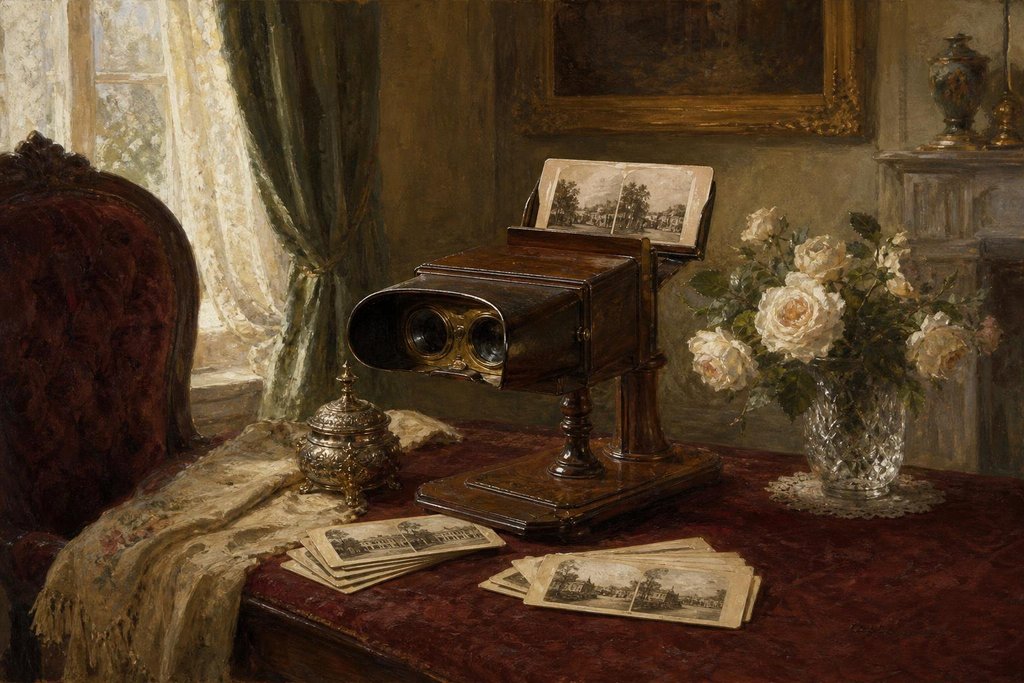
Long before television reached rural Oklahoma, a grandmother’s stereopticon showed a young Cindy Pickett the world. Decades later the actress kept her own viewer and a shelf of Victorian and Edwardian cards.
Cindy Pickett, from Guiding Light to Ferris Bueller’s Day Off
By 2011 Cindy Pickett had worked in film and television for 35 years. She played Jackie Marler-Spaulding on the soap opera The Guiding Light from 1976 to 1980, Vanessa Sarnac on the ABC series Call to Glory from 1984 to 1985, and Dr. Carol Novino on the hospital drama St. Elsewhere from 1986 to 1988.
She was probably best known as Matthew Broderick’s sweet, unsuspecting mother in Ferris Bueller’s Day Off (1986), the coming-of-age comedy written and directed by John Hughes. Off screen, her collecting interest was far older than any of those roles. Pickett collected stereopticon cards, the paired photographs that Victorian and Edwardian families slipped into a viewer to see pictures in three dimensions.
What stereopticon cards are
Stereopticons were the high-tech home entertainment of their time, popular from about 1850 to 1940. Each card carried two photographs of the same scene or object, taken from slightly different positions, one for each eye. Placed in the viewer, the pair merged into a single image with depth.
The viewers were wooden devices with metal trim and were costly in their day, yet they became so popular that one could be found in most Victorian parlors. The model that caught on in the United States was co-invented by Oliver Wendell Holmes. Its simple open design, with a pair of lenses and a sliding holder for the card, helped put stereo viewing within reach of ordinary households.
For collectors, the cards themselves hold most of the interest. Publishers produced them by the thousands in sets on travel, landmarks, news events, comedy and nature, and the printed caption and publisher’s imprint on the mount are the starting point for dating a card. Most surviving cards are black and white photographs; color was added on some by tinting, and those are less common.
A grandmother’s stereopticon on an Oklahoma farm
“I grew up on a farm in rural Oklahoma and was always surrounded by wonderful old antiques,” Pickett said from her home in Pacific Palisades, California, just outside Los Angeles. “I remember my grandmother had an old wood-burning stove, and I just loved the feeling that came from being around objects from another time.”
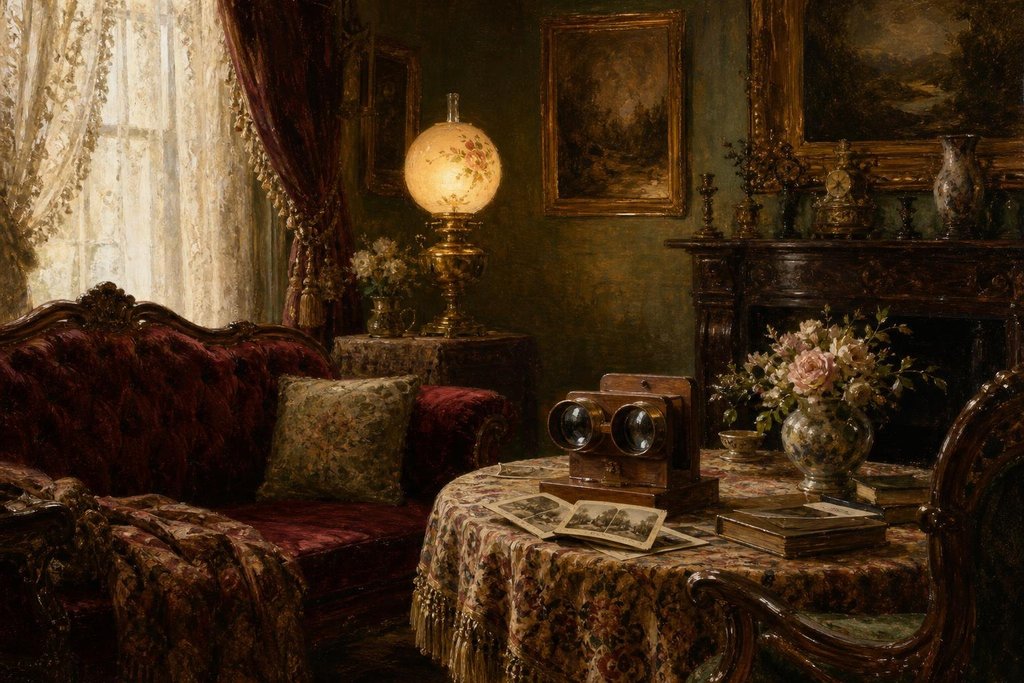
Her grandmother also owned a stereopticon. “For us it was our television,” Pickett said. In the early 1950s there was no TV where the family lived, so when other children or company came over, everyone took turns looking at the cards. “It was a way to look at places in the world or scenes in 3-D that we otherwise would never get to see.”
In her 20s, living in New York, Pickett bought a stereopticon of her own and began collecting cards, most of them made in the late 1800s and early 1900s.
Cindy Pickett’s favorite card: the 1904 St. Louis World’s Fair
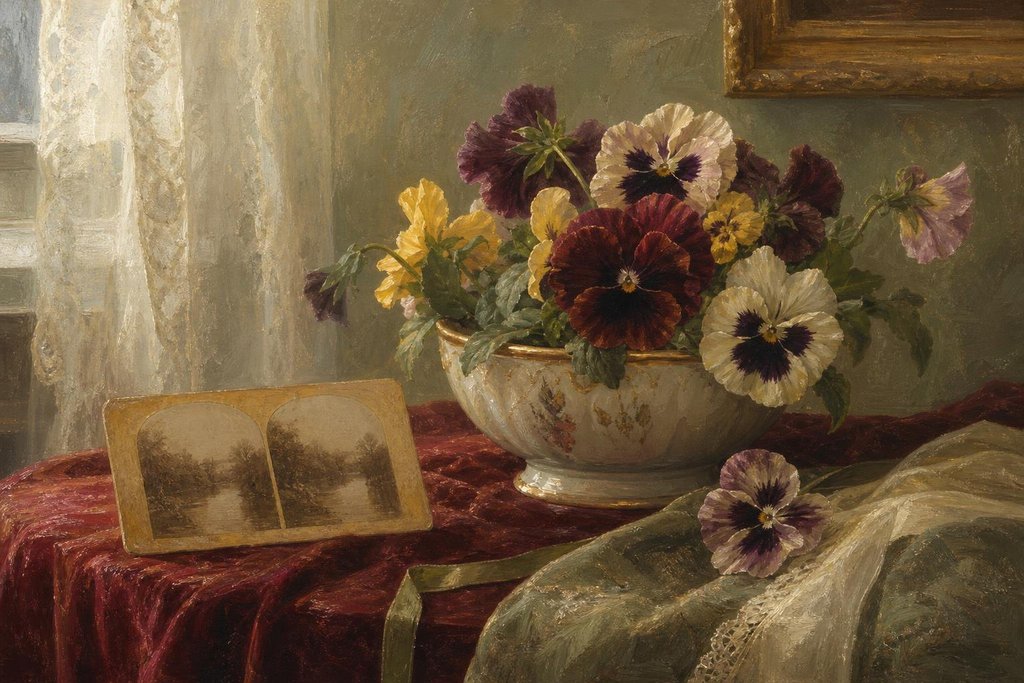
“I guess I’ve got around 30 cards,” she said. “They are getting harder and harder to find.” Only one of hers was in color, a 1904 view of a bowl of pansies. “Believe it or not, it’s not as vivid as the ones in black and white,” she said. Her favorite came from the Louisiana Purchase Exposition, the St. Louis World’s Fair of 1904. “It’s just beautiful.”
The rest of the collection ranged around the globe. There was the Flatiron Building in New York City, a fish market in Finland, a roulette room in Monte Carlo, a giant sequoia in Yosemite National Park and the city hall in Cape Town, South Africa. One card showed Kroll’s Garden, the well-known Berlin beer garden, in 1902. Others pictured a full moon, a Civil War scene of a Union soldier writing a letter on top of a drum, and a 1902 view of bullock skins used as ferry boats in Punjab, India. Like most publishers’ stock, they covered travel, nature, landmarks and buildings, plus whatever else the makers thought would sell, and a few were even naughty for their time.
Some read as small slices of daily life. In one card from 1898, a little boy and girl pose in a play-doctor scene, the boy announcing, “She has symptoms of smallpox.” In another, a woman talks on a wall-mounted crank telephone above the tagline “The quicker way to spread the news, the telephone!” Readers interested in early photography as a collectible may also enjoy the article on Golden Age Hollywood celebrity photos.
Antiques at home: Vermont weekends and a shop job
Pickett kept her stereopticon on a bookshelf at home and gladly brought it out when guests asked about it. The cards were what she considered a true collection, but she had loved antiques for years and decorated her house in an eclectic blend of old and new.
“When I used to live in New York City, I had a boyfriend who had a house in Vermont, and we’d go there on weekends to shop for antiques there and back,” she said. “I still have many pieces from those days. I even worked in an antique shop at one time. I’d spend all my time arranging and rearranging the pieces when no one was there. I just loved it.” Other actresses whose collections have been profiled include Catherine Hicks and Joan van Ark.
Cecil Pickett, Houston and a career on stage and screen
Cindy Lou Pickett was born on April 18, 1947, in Norman, Oklahoma. Her grandparents were Dust Bowl sharecroppers in the Depression. Her father, Cecil Pickett, became a high school teacher and moved the family to Bellaire, Texas, near Houston, when Cindy was 9. She was already a stage veteran by then: at six he had cast her as a flower girl in Our Town. “After that, I was hooked,” she said.
Cecil Pickett went on to teach dramatic arts at the University of Houston, where his daughter studied under him. He became known as something of a star-maker; his students included Randy and Dennis Quaid, Brent Spiner, Trey Wilson and Robert Wuhl.
Cindy stayed in Texas through most of her 20s, then earned her Equity card and tried New York. Within a month she had landed The Guiding Light and a Broadway role in the musical revue Sunset, playing Mary Travers of Peter, Paul and Mary. Her first film was Roger Vadim’s Night Games in 1980, followed by Margin for Murder, in which she played Mike Hammer’s devoted secretary.
She guest-starred on Simon & Simon, Magnum, P.I., L.A. Law, Murder, She Wrote, NYPD Blue, CSI: Miami and Burn Notice, among others, and appeared in I Know My First Name Is Steven (1989), DeepStar Six (1989) and Crooked Hearts (1991). In 2011 she had just finished the independent film Mother Country. She also taught acting, was a master gardener and photographer, and was writing a screenplay her father had begun about small-town life in Dust Bowl Oklahoma.
Questions and answers
What does Cindy Pickett collect?
In 2011 Cindy Pickett collected stereopticon cards, the paired photographs viewed in 3-D through a stereopticon. She owned around 30 cards, most made in the late 1800s and early 1900s, along with her own viewer. Her favorite card showed the 1904 Louisiana Purchase Exposition in St. Louis.
Who did Cindy Pickett play in Ferris Bueller’s Day Off?
Cindy Pickett played the sweet and unsuspecting mother of Matthew Broderick’s character, in Ferris Bueller’s Day Off (1986), written and directed by John Hughes. It was probably her best-known role.
What TV shows was Cindy Pickett on?
Cindy Pickett played Jackie Marler-Spaulding on The Guiding Light (1976 to 1980), Vanessa Sarnac on Call to Glory (1984 to 1985) and Dr. Carol Novino on St. Elsewhere (1986 to 1988). She also guest-starred on Magnum, P.I., L.A. Law, Murder, She Wrote, NYPD Blue and Burn Notice.
What is a stereopticon card?
A stereopticon card holds two photographs of the same scene, one for each eye. Seen through a stereopticon viewer, they combine into a single image with depth. The viewers were popular from about 1850 to 1940, and cards covered travel, landmarks, nature, news and comic scenes.
Where is Cindy Pickett from?
Cindy Pickett was born on April 18, 1947, in Norman, Oklahoma, and grew up partly on a farm in rural Oklahoma. When she was 9 her family moved to Bellaire, Texas, near Houston, where her father, Cecil Pickett, later taught dramatic arts at the University of Houston.