
The Celebrity Collector - Adrienne Barbeau
The star of Maude, The Fog and Escape From New York had one firm rule for her antiques: if it could not be used, she did not buy it.
Adrienne Barbeau’s rule: every collection has to be useful
“All of my collections are practical,” Adrienne Barbeau said with some pride. “You’ll never catch me buying something just to stick in a hutch or curio cabinet. It has to be useful.”
She meant it. At her Spanish bungalow outside Los Angeles, Fiesta was the everyday dinnerware. At a second home on the New Jersey shore, antique Ironstone did the same job. American primitive furniture filled the California house, antique quilts were used as throws, and old wooden firkins held the trash.
Firkins are old wooden sugar buckets, often banded and fitted with handles and lids, and they can bring handsome prices among collectors. Barbeau saw them as furniture. “They’re ideal as low end tables, being about 15 inches high,” she said. “I stack things on them, or use them for storage. I’ve also got them in my bathrooms, where they make good waste baskets. The tops are great, they keep the dogs out.” The dogs were Rain and Mertz, her cocker spaniels.
Life on film sets fed the habit. Collecting, she said, “gives me something to do while on location. There’s a certain amount of delight going to a new town and finding a piece that an unsuspecting owner, or even a sly proprietor, might not know the real value of.”
How a Pittsburgh shop started her Fiesta dinnerware collection
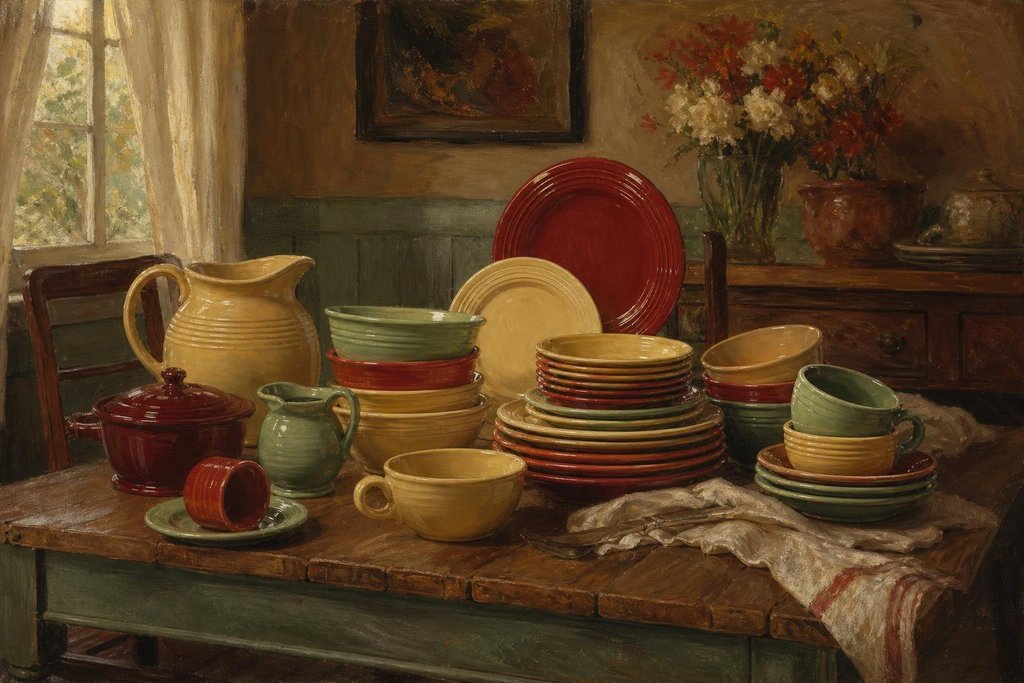
Two of her collections began in Pittsburgh, where she was filming George Romero’s Creepshow. The first was Fiesta, the riotously colorful dinnerware made by Homer Laughlin. “I fell in love with it, but was hesitant to make it a collectible because I didn’t think I’d be able to assemble matching sets,” she remembered. Then she walked into a Pittsburgh shop that was teeming with it. “I ended up shipping home complete place settings for twelve,” she said, laughing. “I just about bought up the place.”
Her Fiesta came in the original colors (cobalt blue, red, aqua, cream, yellow and green) plus the grey, pink, dark green and chartreuse added in the 1950s. Collectors sort Fiesta by these color groups, since the later colors were made for a shorter time and help date a piece.
The red pieces gave her pause when her son Cody was born. “I was worried about radiation in the red pieces. I knew they had uranium in them, because that’s what made the ones made during World War II scarce,” she said. “I had the fire department come out with a Geiger counter to take a reading.” The fire department gave the dishes a clean bill of health, but she still kept the red pieces in a high cupboard, out of reach of her identical twin sons, William and Walker, who were four and a half at the time. She had the twins after 50 with her husband, producer-director Billy Van Zandt, and joked, “I was the only woman on the maternity ward who was a member of AARP!”
Antique quilts on the beds, not in the closet
The quilt collection also started in Pittsburgh, at the home of a woman whose house was decorated entirely in oyster plates. “I thought that was incredible,” Barbeau said. “But she also collected and sold quilts out of her house, and I bought two Amish pieces. That got me started.” She gave one to her mother-in-law. The other, which she kept, is signed “Aunt Mary, 1915.”
By 2002 she had about 30 quilts in nearly every style except crazy quilts, among them appliqués, a Lone Star, many from the 1930s and some from the 1800s. Two favorites were American pieced cotton quilts, 84 inches long, in the Trip Around the World pattern. “I just love textiles,” she said. “And, like my other things, I use them. A few are on the wall, but the others are on the boys’ beds, or used as throws, or whatever.”
Storage was another matter. Each quilt was wrapped in acid-free paper, slipped into a pillowcase and then put in a storage box. Oddly, the only quilt that ever showed unusual wear was one that had hung on a wall for years, out of direct sun. “I began noticing these brown stains, and I couldn’t figure out how they were getting there,” she said. “We never did solve the mystery.”
American primitive furniture in the California house
Her interest in American primitive furniture began around 1980, when she bought her California house and decorated it with help from designer Karin Blake, later named one of America’s top 100 designers by Architectural Digest. “Karin wasn’t known that much back then, so I was fortunate to have her work for me,” Barbeau said. “She knows about everything there is to know about American primitive. She helped me find the early pieces.”
Favorites around the house included a Rococo revival cast-iron bed she bought for $150 in St. Louis while filming Escape From New York, a mid-19th-century American country pine step-back cupboard and an 81 by 56 inch country cupboard painted orange, grey and mustard that she kept in a bathroom. A goat cart in its original blue paint had become a coffee table.
There was also a 19th-century English carved glider hobby horse from Ashland, Oregon (“the boys ride on it, my husband hates it”), a sleigh-shaped bentwood and iron field cradle from the late 1800s, a blue-grey American Federal style painted cupboard 87 inches high, and a step-back cupboard with its original glass and blue paint. Bentwood bow-back armchairs, painted trunks, a painted buckboard seat and “lots of painted coffee bins” filled in the rest.
English Ironstone for a 1910 New Jersey farmhouse
Ironstone was her newest collection. This 19th-century white earthenware is also called Stone China or, in America, White Granite Ware. “I needed some dinnerware for the house in New Jersey, a 1910 farm house,” she said. “The Ironstone just seemed like a good fit. I’ve got all these mismatched pieces, but it’s all English and it’s all antique, with the exception of some American-made pieces I picked up along the way.”
She owned dinner plates, serving pieces and salt and pepper shakers marked by makers such as Adams, Johnson Bros. and Alfred Meakin. Most came through eBay, which had its risks: one sugar bowl arrived in pieces because the seller had not wrapped it properly. Ironstone can develop brown marks over time that look like iron stains, and these can be bleached out chemically. For other practical American wares, see Southern stoneware, and for buying tips online, what sells on eBay.
Adrienne Barbeau’s career from Broadway to Batman
Barbeau was born to a French-Canadian father and an Armenian mother and grew up in northern California and the Central Valley. She started dance lessons at three and voice lessons in fifth grade, and at 15 she was accepted into the San Jose Light Opera. She left Foothill College at 19 to go on a USO tour with the company, then moved to New York to study acting.
Her first break was the role of Hodel in Fiddler on the Roof on Broadway. She earned a Tony nomination as the original Rizzo in Grease, then played Carol on the television series Maude. Film audiences knew her from The Fog, Escape From New York, Cannonball Run, Swamp Thing, Creepshow, Two Evil Eyes and Back to School. In 2002 she had a recurring role as Oswald’s mother on The Drew Carey Show, voiced Catwoman in Batman: The Animated Series and had just released a self-titled CD of country, blues, rock and folk songs. Fellow actresses with notable collections include Joan van Ark and Dolly Parton.
Questions and answers
What does Adrienne Barbeau collect?
In 2002 Adrienne Barbeau collected Fiesta dinnerware, about 30 antique quilts, American primitive furniture, wooden firkins and English Ironstone. Her rule was that everything had to be useful, so the Fiesta was her daily dinnerware, the quilts went on beds and the firkins served as end tables and waste baskets.
Why did Adrienne Barbeau test her Fiesta with a Geiger counter?
When her son Cody was born, Barbeau worried about the red Fiesta pieces because she knew the glaze contained uranium. She had the fire department come out with a Geiger counter. The dishes got a clean bill of health, but she still kept the red pieces in a high cupboard away from her young twin sons.
Who is Adrienne Barbeau’s husband?
At the time of the 2002 interview, Adrienne Barbeau was married to Billy Van Zandt, a producer-director and the brother of E Street Band guitarist Stevie Van Zandt. They had identical twin sons, William and Walker, born when she was over 50. Her older son, Cody, was from an earlier marriage.
What is a firkin, and how did Adrienne Barbeau use them?
A firkin is an old wooden sugar bucket, often banded and fitted with handles and a lid. Barbeau used hers, about 15 inches high, as low end tables and for storage, and kept some in her bathrooms as waste baskets. The lids, she said, kept her cocker spaniels out.
What movies and shows is Adrienne Barbeau known for?
Adrienne Barbeau played Rizzo in the original Broadway Grease, earning a Tony nomination, and Carol on Maude. Her films include The Fog, Escape From New York, Cannonball Run, Swamp Thing, Creepshow and Back to School, and she voiced Catwoman in Batman: The Animated Series.
Further reading
Elsewhere on the web: Adrienne Barbeau, the actress’s official site.