Art & Artists: The Highwaymen, Featured Painters and Celebrity Artists
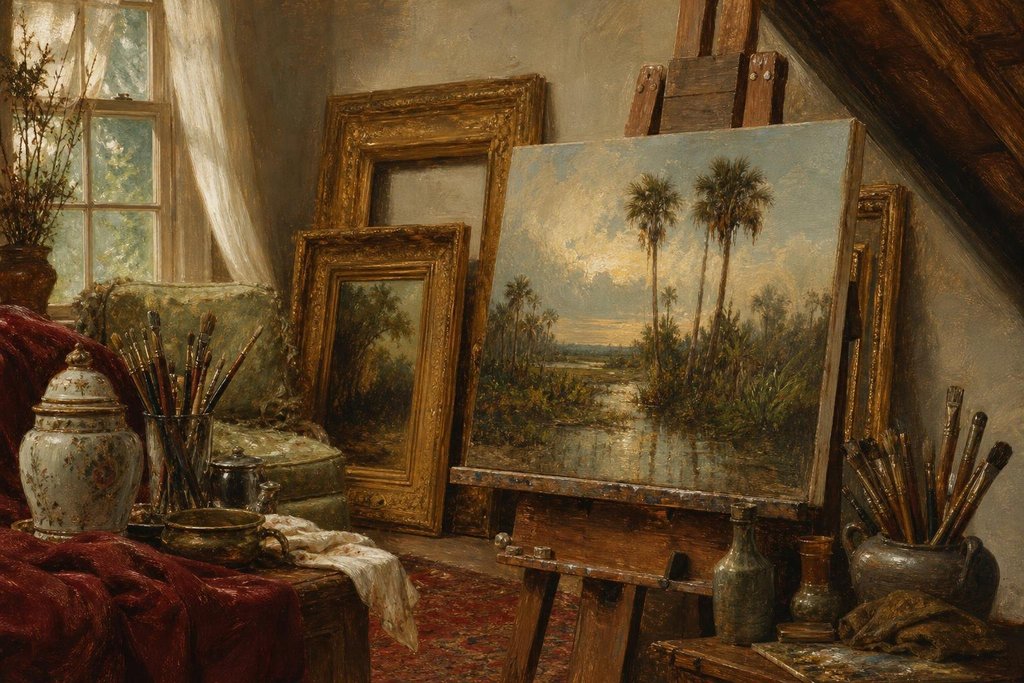

Five artists with very different routes to the easel: roadside painters in Florida, a Russian-born Expressionist, a college football coach, a Bond film actress and a mime who settled in Sedona.
Featured painters and celebrity artists
Art & Artists covers painters whose work collectors seek out, and performers who turned out to be serious artists. The Featured Artist pieces look at painters on their own terms: a group of self-taught Florida landscape painters, an Expressionist who slipped into obscurity, and a football coach who painted hundreds of portraits of his players. The Celebrity Artist pieces turn to people known first for film and television whose art grew into a second career.
Each article follows the artist’s path, the way the work was made and sold, and what the sales record looked like at the time it was written. Prices quoted are historical, tied to the year of the sale.
The Highwaymen: Florida landscapes sold from the roadside
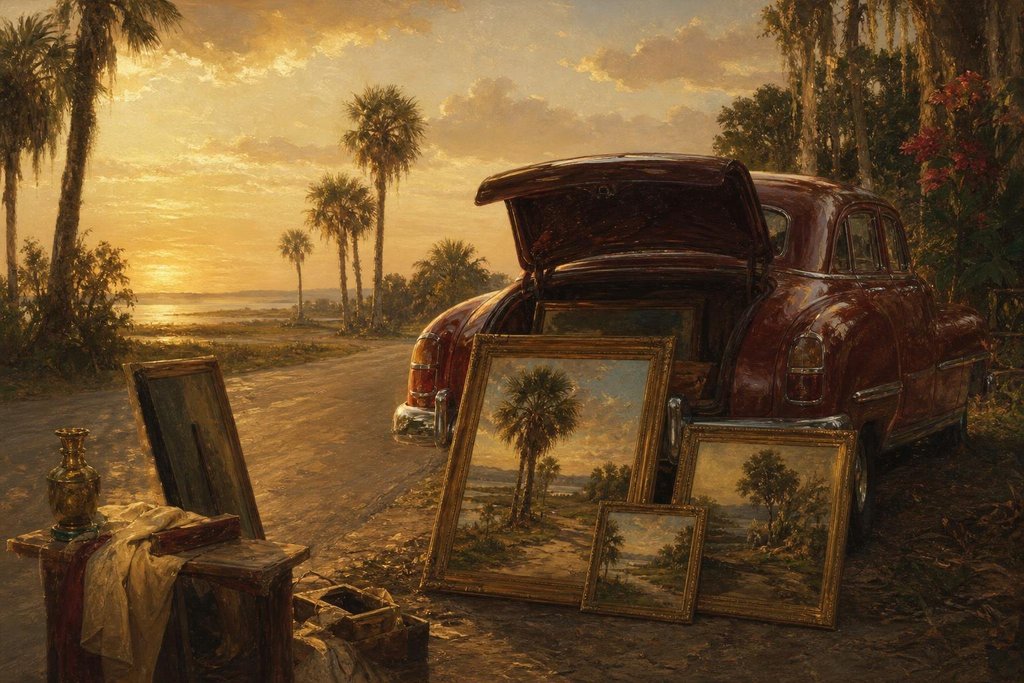
The Highwaymen were a loosely associated group of young African-American artists in the Fort Pierce area of Florida from the 1950s through the 1970s. They took the name from the way they sold their work, often still wet, at the roadside or out of a car trunk. They painted on inexpensive roofing material and framed the pictures in white crown moulding. Of the 26 painters, all were men except one woman, MaryAnn Carroll, and for most of them painting was a way out of picking or crating oranges in the local groves.
The group’s start is traced to 1954, when the young painter Harold Newton met the established white painter Albert “Beanie” Backus, who encouraged him to paint landscapes. Alfred Hair also studied under Backus. Working with a heavy palette knife, the painters produced swaying palms, shifting skies, Atlantic surf, marshes, birds and moss-laden trees along the St. John’s River, selling them for about $25 each. They are estimated to have produced about 50,000 oil paintings before disbanding in the 1980s.
Interest revived after Gary Monroe’s 1998 book The Highwaymen. By 2004 an original could easily bring $5,000 or more, and one of the largest collections, about 300 paintings gathered by Geoff Cook and his wife, began with a Harold Newton bought from the Salvation Army for $40.
Sacha Moldovan, the Russian-born Expressionist
Sacha Moldovan (1901-82) was born Aloysha Schneider in Kishinev, Russia, and later took his mother’s maiden name. His family fled to New York on the eve of the Russian Revolution, and he studied at the Cooper Union and the National Academy of Design before moving to Paris in the early 1920s, where Henri Matisse and Pierre Bonnard are said to have taken him under their wing.
His style drew on Matisse, van Gogh and Chaim Soutine: arbitrary color, thick impasto and black outlines. He distrusted critics and dealers and held on to his best work. Even so, his prices rose, from $6,000 to $8,000 at the Allan Rich Galleries in the early 1970s to $18,000 in 1984 and more than $50,000 at a 1991 one-man show at Hammer Galleries in Manhattan.
The critic Marla Berg summed him up this way: “Had van Gogh painted Matisse’s pictures while dreaming of Chagall, the result would have been the works of Sacha Moldovan.” Chagall, also Russian born, knew him, and a 1984 show in Durham, North Carolina, hung the two painters side by side.
Harold “Tubby” Raymond, the coach who painted his players
Harold “Tubby” Raymond coached football at the University of Delaware, won three Division I-AA national championships and became only the ninth coach in college history to reach 300 victories. His painting began as an assistant coach, when head coach Dave Nelson asked his staff to draw cartoon sketches to lighten the atmosphere. Raymond moved on to portraits.
For years he painted every starter during his senior season: the player’s likeness, the Blue Hen mascot and an inspirational saying aimed at that week’s opponent, finished by the Thursday before the game and hung in the locker room. Some of the hundreds of acrylic portraits were done in under 45 minutes, and after he retired following the 2001 season he painted every day.
Barbara Carrera and the Hollywood Legends portraits
Barbara Carrera, Fatima Blush in the 1983 Bond film Never Say Never Again, was born in Managua, Nicaragua, in 1951 and showed her paintings at Makk Galleries in Beverly Hills and the Roy Miles Gallery in London. Her Hollywood Legends series, 22 oil-on-canvas portraits mostly 30 by 40 inches, took three years and included Bette Davis, Sean Connery, Greta Garbo and Grace Kelly. She worked in the Old Masters’ way, from the darkest tones toward light, and called Garbo her most resistant subject.
Her path to painting was slow. Sent to a convent school in Memphis at ten, she studied piano more than art and only dabbled in watercolors. Encouraged later by her Indian guru, she began painting in oils, and her early, mystical work was shown under the title “Metamorphosis” in California and then London, where a painting with Elvis in a strange context sold right away. Her Old Masters method came from meeting a restorer who worked on museum paintings in England.
Robert Shields, from mime to Sedona design
Robert Shields was the male half of the mime team Shields and Yarnell, who had their own CBS variety show in the late 1970s. Marcel Marceau offered him a scholarship in Paris, and Red Skelton saw him perform in San Francisco’s Union Square. In Sedona, Arizona, he founded Robert Shields Design, which by 2004 ran four retail stores and made metal wall art, masks, jewelry and pewter shaped by the colors of the Southwest. Mask making, he said, came from the influence of the Commedia dell’Arte.
His own beginnings were unlikely. Born and raised in California, he did not talk until age four, flunked the third grade and stuttered until he was seventeen. After high school he joined a traveling circus in Canada as “Robbie the Robot.” He met the dancer Lorene Yarnell in 1972; each taught the other a craft, and they performed in the streets as a team before television made them stars.
Art & Artists
Questions and answers
Who were the Florida Highwaymen?
The Highwaymen were 26 African-American painters, all men except MaryAnn Carroll, working around Fort Pierce, Florida, from the 1950s through the 1970s. They sold Florida landscapes for about $25, often still wet, from the roadside or the trunk of a car. The group traces its start to 1954, when Harold Newton met the painter Albert “Beanie” Backus.
How many paintings did the Highwaymen produce?
It is estimated that the Highwaymen produced about 50,000 oil paintings before they unofficially disbanded in the 1980s, when the popularity of the genre waned and most turned to other jobs. Interest returned after Gary Monroe published his book The Highwaymen in 1998, and by 2004 an original could bring $5,000 or more.
Did Barbara Carrera paint?
Yes. Barbara Carrera, known for playing Fatima Blush in Never Say Never Again, exhibited at Makk Galleries in Beverly Hills and the Roy Miles Gallery in London. Her Hollywood Legends series is 22 oil portraits of film stars, most 30 by 40 inches, painted over three years using the Old Masters’ method of working from dark tones toward light.
Who was Sacha Moldovan?
Sacha Moldovan (1901-82) was a Russian-born Expressionist painter who emigrated to New York, studied in Paris in the 1920s and admired Matisse, Bonnard, Soutine and above all van Gogh. He refused to sell his best works and distrusted dealers, yet his originals sold for more than $50,000 at a Hammer Galleries show in 1991.
What did Tubby Raymond paint?
Harold “Tubby” Raymond, the longtime University of Delaware football coach, painted acrylic portraits of every starter during their senior season, each with the Blue Hen mascot and an inspirational saying for that week’s opponent. The portraits hung in the Delaware locker room. After retiring in 2001 he painted daily and took commissions.