|
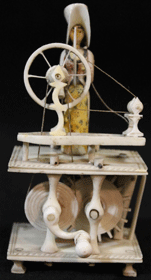
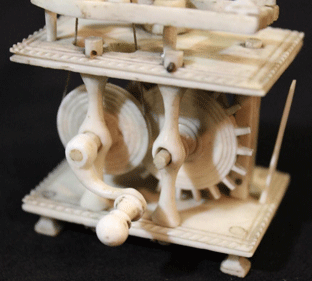
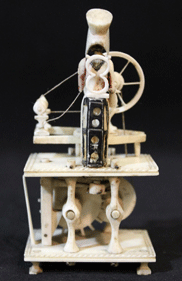
$1,384 (34 bids): Antique French Folk Art Prisoner of War Miniature Bone Spinning Wheel Automaton. This antique, mid-19th century Miniature Folk Art Automaton is remarkable. It measures only 1.25 inches wide by 2 inches long, and the height to the top of the lady's large bonnet is 4 1/8 inches. She has a wonderful folk art face under her bonnet, and there are traces of the original paint to her dress. Underneath the floor is the combination of gears that make this lady spin her wheel with one hand while spinning the wool in her other hand. As the handle is turned, she lifts her left arm, pulling the wool, and she turns her head at the same time; all while spinning the wheel.
After a search on the internet, I found a couple of similar examples that were described as French prisoner of war creations, which were made from scraps of cow and pig bones. As you might expect, something this delicate must have been carefully taken care of all these years.
There are no breaks or missing pieces; however, we did find that the small piece that comes up next to the spinning wheel is an old replacement. The sewing thread, which connects the gears and pulleys to the spinning wheel as well as operates the lady's left arm, are loose and need replacing. I guarantee that once a strong thread is properly attached, this automaton will work perfectly once again. When I turn the crank even now, the lady lifts her arm and turns her head. (Photo, courtesy of eBay seller wwolst12.)
DBA: Before seeing this sale, I was not familiar with Folk Art Prisoner of War items. The detail on these objects is amazing. I thought that surely I would not find anything similar. The prices for these bone structures vary greatly. I found two similar objects selling at small British auction houses for £270 and £700 pounds (about $438 and $1,135, respectively). But Sotheby's sold one from Brooke Astor's estate on Sept 24, 2012 for $3,438, including buyer's premium. The one from that sale was slightly larger and had four women instead of one. This type of object is so rare that it is difficult to predict future viability of value. If comparing it to the Brooke Astor sale, it appears to be a good buy.
Several books have recently been published: The Arts and Crafts of Napoleonic and American Prisoners of War 1786-1816 by Clive Lloyd and A History of Napoleonic and American Prisoners of War 1756-1816. The second book is a detailed account of the historical background to the wars that saw these men become prisoners. The two-volume Napoleonic and American Prisoners of War 1756-1816 is research into the actual men imprisoned.
* * * * * * * * * * * * * * * * *
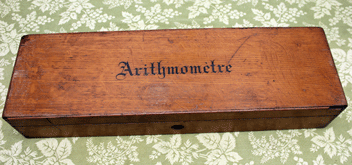
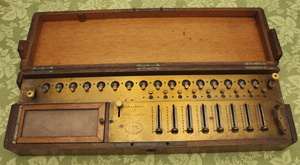
$4,539 (7 bids): Arithmometer, Antique 1880's Calculator. This is an amazing piece of scientific history. Made in France by Louis Payen in the 1880s, the Arithmometer was state of the art for its time in calculating for banks, businesses, accountants, etc.
We just got back from the Antiques Roadshow in Cincinnati where we had this item appraised. The appraiser said that it was in very good condition for an item of its age and that had been used at one time in a business of some sort.
Ivory knobs. All mechanisms are free and working. There is one small corner piece broken on the front right top corner. Other than that, it is original patina and natural wear. (Photo, courtesy of eBay seller rion 819.)
DBA: The arithmometer was patented by Thomas de Colmar in 1820 in France. After patenting the device, Thomas de Colmar raised money in other businesses to manufacturer the device. The mechanical calculator was made from 1851 to 1915. Louis Payen managed the plant operation in the late 1880s. This was considered the golden age for the manufacturer of the device.
This one sold on eBay is from this period and has 16-digit capacity. Other companies produced "clones" of this invention. While the arithmometer continued to be produced and used, this French company faced problems due to WWI. The company was sold in 1915, but shortages of materials and the lack of trained, qualified workers caused it not to be viable.
This is a high price for a mechanical calculator, but this one is special. Many British and German "clones" can be found but fewer from the original French company.
* * * * * * * * * * * * * * * * *
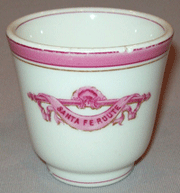
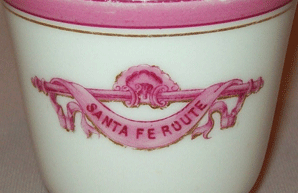
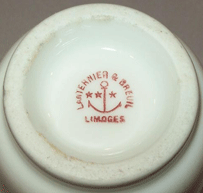
$3,181 (26 bids): Very Early Santa Fe Route Railroad Limoges China Cup. A very early cup measuring approximately 3 inches in diameter, not counting the handle, and 2 7/8" in overall height. The bottom is marked "LANTERNIER & BREUIL LIMOGES" around an anchor and three stars. There are two tiny 1/8-inch-diameter flat flakes side by side on the top front rim and a 1/8-inch flat flake on the bottom left-hand edge of the footed base. There is also some minor light wear to the gold highlight decoration around the banner emblem. The pattern seems to be extremely scarce, and I believe quite early. (Photo, courtesy of eBay seller americaspride.)
DBA: Frederic Laternier began as a Limoges porcelain exporter in 1857. The Lanternier and Breuil label would have been from 1885 to 1887, a short period of the partnership.
Railroad objects are a separate collectible grouping where I would expect the objects to trade for three to four times more than the base object. In other words, a cup would be worth three to four times more as a railroad collectible than as a regular cup.
But this cup sold for $3,181, and I cannot find a reason for this price. The Santa Fe Railroad began in 1857, and the markings on this cup are from 1885 to 1887. This is not the earliest Limoges china, and it appears to be whiteware, not fine porcelain.
Limoges was the premier imported china at that time, and it was prominently decorated with the Santa Fe label, but it is still a lot of money. I would say the seller got the deal in this case.
* * * * * * * * * * * * * * * * *
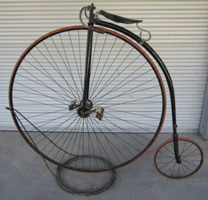
$6,212 (18 bids): High Wheel Penny Farthing Bicycle, G & J, Chicago. Dates from 1888-1890; 52-inch driving wheel with 7/8-inch tire; 17-inch rear wheel with 3/4-inch tire. The celebrated Lillibridge saddle is furnished with this machine. This bike has the upgraded, solid rams-horn handle bars and ball bearing pedals; both of these would have been an option to the "standard" Challenge which came with cow-horn handle bars and parallel bearings in the pedals. These options added an additional $6.50 to the cost. Also, upgrades include ball bearings in both wheel axles; this feature cost an extra $11 to the already pricey $79 for the bicycle in 1888 ($79 then is $1,926 now).
The handle bar grips are in excellent condition. It and the seat all are nickel-plated, although tarnished. The mounting step is correct and complete. The tires are not worn, as this bike can be ridden today and for many years to come just as it stands! Both wheels are solid and true, no missing spokes and all original spokes. Tight wheel base that shows no damage to any parts. (Photo: courtesy of eBay seller main-drain, http://www.weknowallaboutpools.com.)
DBA: At the height of production, this was just known as a bicycle. The name penny farthing is a British term and comes from the two coins, the penny and the farthing, with the penny being the larger of the two. From a side view, the two coins resemble the wheels of the bicycle.
This type of bicycle was faster. The large wheels also were smoother on cobblestone roads prevalent at the time. These bicycles were more dangerous as falling off or "taking a header" could even prove fatal. Going downhill, you may see the rider place his feet on the handlebars to try to prevent going headfirst in the event of a fall.
The penny farthing bicycle can be found for about $1,000, but not the deluxe version. Finding an original bicycle with all of the features that this one has is what drove up the price. I think the buyer got a good deal.
Deborah Abernethy is a certified appraiser with the International Association of Appraisers. She can be contacted at 404-262-2131 or Deborah@expert-appraisers.com
. Her website is www.expert-appraisers.com
.
|